
Lexington, SC · Garage Door Service
Why a Door Goes Off Track in Lexington
Lexington's housing stock runs 1965-2010, median build year 1984. That track age plus mild-with-freeze winters is why doors jump track here. Here's the why.
- Repairs & new doors
- Springs & openers
- Serving 7 nearby communities
The Problem
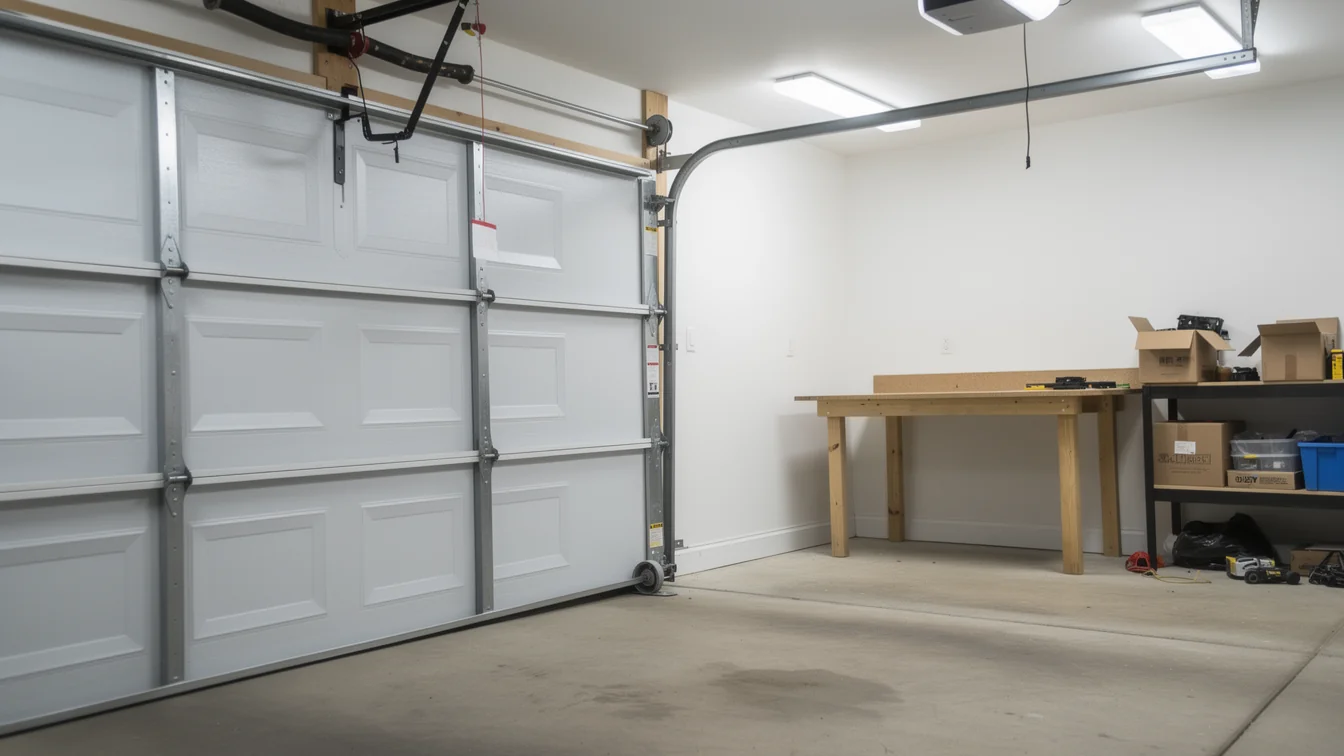
A door that's jumped its track almost always started with something small: a roller that wore down, a track bracket that worked loose, or a cable that frayed and let one side of the door drop before the other. Once a door is even a quarter-inch off level, the rollers start riding the edge of the track instead of the center groove, and every open-close cycle after that makes it worse.
In Lexington, the age of the door matters more than people think. Housing across the service area was mostly built between 1965 and 2010, with the median home going up around 1984. That means a lot of garage doors and openers out there are original or close to it, running on hardware that's forty-plus years old in places like Oak Grove, Red Bank, and the other nineteen areas we work across. Track brackets on doors from that era were often fastened with lag screws into jamb wood that's shrunk and loosened over four decades. The track hasn't moved, but the framing around it has, just enough to let the track rack out of square.
By the time a homeowner notices, the door usually isn't rolling smoothly anymore - it's grinding, catching, or hanging up a few inches from full open. That's the track telling you it's no longer parallel to the panel travel.
Where People Go Wrong
The most common mistake we see is someone tightening the track bolts and calling it fixed. That buys a few weeks. If the bracket is pulling out of old jamb wood, re-tightening the same screw into the same stripped hole doesn't hold - it strips further, and the next time the door drops off track it usually takes a roller or a section of track with it.
The second mistake is ignoring a door that's merely noisy before it jumps track outright. A door that grinds or hesitates on one side is already running out of alignment. Waiting until it fully derails means a bigger repair - bent track, a cracked panel seam, sometimes a broken roller stem.
The third is DIY realignment on a door that's still under spring tension. Bending a track back into place while the door is closed and the springs are loaded is how people get hurt, and it's also how you bend the track again somewhere else. This is one job where guessing costs more than calling someone who does it daily.
We also see people replace rollers without checking what made them fail in the first place - usually a track that's already slightly bent, so the new roller wears the same way the old one did within a year.
What Local Conditions Do
Lexington sits in a mild climate with occasional freeze - not the wide swings that crack concrete slabs or warp steel tracks the way harder winters do, but enough cold snaps each year to matter. A track bracket that's already loose in aging jamb wood gets a little looser every time the wood contracts in a cold snap and expands back in the next warm stretch. That cycle, repeated every winter since a house was built in, say, 1984, adds up to real slack at the fasteners.
Humidity plays a role too. Wood-framed openings in houses from the 1980s-90s stock that make up most of the area's inventory can swell slightly in summer and pull back in cooler months, and the track bracket is caught in the middle of that movement every time. It's not dramatic the way a hard freeze-thaw region is, but it's steady, and steady is what eventually walks a bracket loose.
None of this is the kind of thing a homeowner can see from the driveway. The symptom shows up as a door that drifts off track, but the cause is years of small seasonal movement in framing that was never built to be checked.
The Cost of This Job
We don't have a flat number to quote here, and we won't invent one - every off-track call we run is priced after we see the track, the bracket condition, and whether the rollers or cables came off with it. A simple re-hang where the track just slipped is a different job than one where the bracket pulled out of rotted jamb wood and needs to be reset into solid framing.
What we can tell you honestly: if the track is bent, straightening it rarely holds for long on a door this age. Replacing that section of track costs more up front but it's the repair that actually lasts, instead of a temporary fix that has you calling again in six months. If your door is original to a house built in the 1965-2010 window that covers most of this area, ask whichever company you call whether they're bending the old track back or replacing it - that answer tells you a lot about the repair you're getting.
Frequently asked questions
My garage door came off the track on one side only - is that worse?
It usually means one cable or roller failed while the other side held, which is actually easier to fix than both sides derailing. But don't run the opener again once you notice it - that uneven pull is what bends track and cracks panel seams. Leave it closed or open where it sits and get it looked at.
Is my door's age the reason it keeps going off track?
Likely a factor. Most houses in this area were built between 1965 and 2010, with a lot of them in the 1980s-90s range, so the track hardware is often original. Decades of small seasonal wood movement loosens the bracket fasteners gradually, which lets the track drift out of alignment.
Can I just push the door back onto the track myself?
Not while the springs are loaded, which they are on any closed or partly open door. We'd rather tell you plainly not to try this than have you get hurt saving a service call. If the door is fully open and off its track with no tension on it, that's a different situation - but most aren't.
Related garage door services in Lexington
More garage door guides
Book garage door service in Lexington
Call now or request a quote - tell us what the door is doing and where you are.